

The cost of Liquefied Petroleum Gas (LPG), commonly known as cooking gas, has continued to soar across Nigeria ahead of the 2026 Eid-el-Kabir celebrations, worsening the financial burden on households already grappling with rising living costs.
The Federal Government had earlier declared Wednesday, May 27, and Thursday, May 28, 2026, as public holidays to mark the Sallah festivities.
A market survey revealed that cooking gas, which previously sold for less than ₦1,000 per kilogramme, now costs between ₦1,500 and ₦2,000 in many parts of the country.
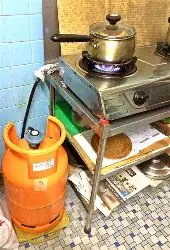
Residents in some South-West communities disclosed that LPG now sells for as high as ₦2,000 per kilogramme in border areas of Ogun State. Consumers in Lagos, Abeokuta and Ibadan also confirmed that the product currently sells between ₦1,600 and ₦1,700 per kilogramme.
In several northern states, the price of cooking gas was said to range from ₦1,800 to ₦2,000 per kilogramme, further deepening concerns over affordability.
A consumer, identified as Madam Juliana, condemned the development, accusing the government of neglecting the welfare of ordinary Nigerians.
“One of the few ways the government can ease the suffering of the masses is by ensuring affordable cooking gas, but our leaders do not seem concerned,” she lamented.
Meanwhile, the Nigerian Association of Liquefied Petroleum Gas Marketers (NALPGAM) has expressed alarm over the steady increase in prices and irregular supply of LPG nationwide.
In a statement jointly signed by its National President, Edu Inyang, and Executive Secretary, Bassey Essien, the association warned that the situation could lead to severe scarcity and worsen economic hardship for millions of Nigerians.
According to the association, marketers currently pay between ₦25.2 million and ₦26.2 million for 20 metric tonnes of LPG, depending on location.
NALPGAM described the development as “sad and very pathetic,” warning that rising prices could spark public anger against gas retailers if urgent measures are not taken.
“We fear that if the situation is not quickly addressed, frustrated citizens may turn their anger against owners of gas filling stations,” the statement noted.
The marketers added that the rising cost of cooking gas is affecting households, food vendors, small businesses and low-income earners who rely heavily on LPG for daily cooking.
The association further warned that the crisis threatens years of progress recorded in promoting clean cooking energy and expanding LPG usage across Nigeria.
“Although millions of Nigerians embraced LPG due to the clean energy transition campaign, those gains are now under serious threat,” the association stated.
According to the group, many households are gradually reverting to firewood and charcoal because of the soaring cost of cooking gas.