

The United States’ 2026 FIFA World Cup dream came to a painful end on Monday as Belgium produced a commanding 4-1 victory in the Round of 16, bringing the curtain down on a campaign that had been overshadowed by one of the tournament’s biggest controversies. The defeat came barely 24 hours after FIFA ignited widespread outrage by allowing American striker Folarin Balogun to play despite his automatic one-match suspension following a straight red card in the previous round.
Balogun had been sent off during the United States’ Round of 32 victory over Bosnia and Herzegovina after a VAR review deemed his challenge on defender Tarik Muharemovic to be serious foul play. Under FIFA regulations, a straight red card automatically attracts a one-match suspension, making him unavailable for the crucial clash against Belgium.
However, in a stunning reversal on Sunday, FIFA’s Appeal Committee suspended the implementation of the ban for a one-year probationary period, allowing Balogun to feature against Belgium while leaving the red card on his disciplinary record. The decision immediately triggered fierce criticism across the football world after reports emerged that U.S. President Donald Trump had personally contacted FIFA President Gianni Infantino to request a review of the striker’s dismissal.
Although Infantino insisted that FIFA’s judicial bodies acted independently and that he could not interfere with disciplinary matters, the explanation failed to calm the growing backlash. European football governing body UEFA described FIFA’s action as “unprecedented, incomprehensible and unjustifiable,” warning that it had “crossed a red line” by undermining the credibility and integrity of the sport. UEFA stressed that football’s laws must be applied equally to every nation regardless of status or influence.
Belgium’s Football Association also protested the decision, saying it had received no satisfactory explanation from FIFA before lodging an appeal. The governing body argued that Balogun should not have been eligible for the knockout tie. FIFA, however, dismissed Belgium’s appeal as inadmissible, clearing the striker to take his place in the American starting lineup. Several current and former football figures also condemned the decision.
Belgium coach Rudi Garcia admitted he initially believed the announcement was an April Fool’s joke, while Norway manager Stale Solbakken described FIFA’s action as “a big mistake” that could damage the reputation of the World Cup. Former England defender Gary Neville also criticised the move, saying the circumstances surrounding the decision had left “a stain” on the tournament. With so much attention focused on Balogun before kickoff, expectations were high that the striker would justify FIFA’s controversial decision. Instead, Belgium dominated the contest and exposed the American defence with a clinical attacking display.
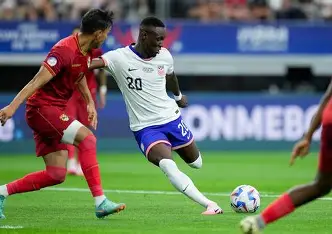
Balogun endured a quiet afternoon, struggling to influence proceedings despite starting in attack. He recorded only 10 touches during the opening half and failed to register a goal. His most significant contribution came midway through the first half when he won a free kick outside the penalty area after being fouled. Malik Tillman converted the set-piece to briefly draw the United States level at 1-1. Belgium, however, quickly regained control and punished the hosts with three more goals to seal an emphatic 4-1 victory and book a place in the quarterfinals.
Balogun’s only clear opportunity after the break was comfortably denied by Belgian goalkeeper Thibaut Courtois before he was substituted in stoppage time. The result marked another disappointing chapter for the United States in the knockout stages of the FIFA World Cup, extending their struggles beyond the group phase despite the advantage of playing on home soil as one of the tournament’s co-hosts.
For Balogun, the defeat ended what had otherwise been an impressive tournament. The striker scored three goals during the competition to equal the second-highest tally by an American player at a single FIFA World Cup and became the first U.S. player since 1930 to score twice in one World Cup match. Yet those achievements are likely to be overshadowed by the extraordinary controversy surrounding his reinstatement. FIFA’s decision to suspend his automatic ban has sparked an intense debate about the independence of football’s disciplinary process, political influence in sport and the consistency of the game’s laws. With Belgium marching into the quarterfinals and the United States heading home, the Balogun saga is expected to remain one of the defining stories of the 2026 FIFA World Cup long after the final whistle.