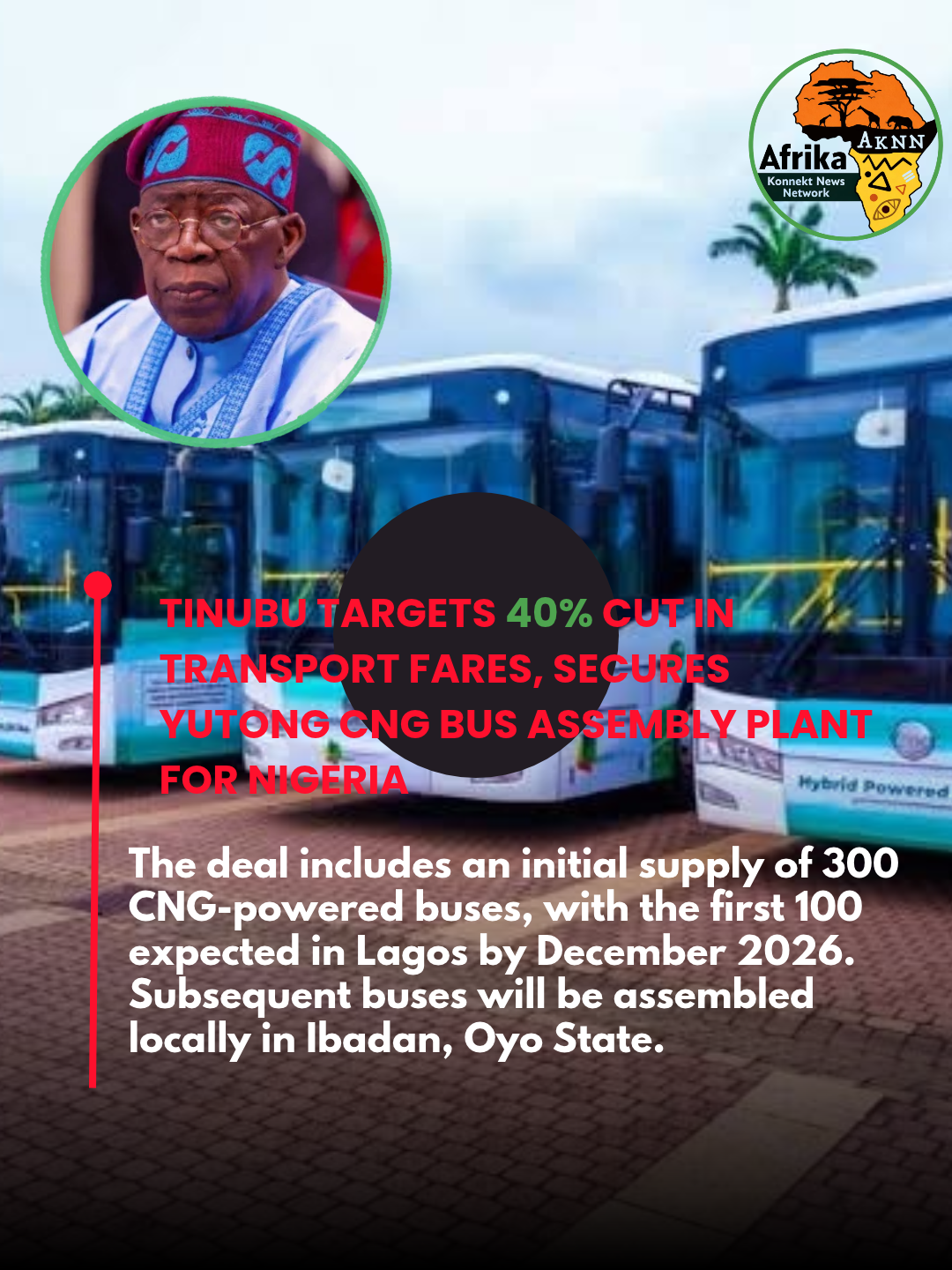

President Bola Ahmed Tinubu has secured a partnership with Chinese automotive giant Yutong, the world’s largest bus manufacturer, to establish a compressed natural gas (CNG) bus assembly plant in Nigeria as part of a broader effort to reduce transportation costs and expand affordable mass transit across the country.
Under the agreement, Yutong will supply an initial fleet of 300 CNG-powered buses, with the first 100 buses expected to arrive in Lagos by the end of December 2026. The remaining buses will be assembled locally at the former Leyland Automotive plant in Ibadan, Oyo State, through YP Automobiles Bus Assembly.
The partnership forms part of the Federal Government’s National Affordable CNG Transit Programme (NACTP) and is expected to support the administration’s target of reducing transport fares by approximately 40 percent on participating routes between 2027 and 2031.
Government officials say the project will help revive Nigeria’s automotive manufacturing sector by restoring activity at the historic Ibadan assembly facility. The initiative is also expected to create jobs for engineers, technicians, assembly workers and other skilled professionals while reducing the country’s reliance on imported commercial vehicles.
Yutong brings significant industry expertise to the partnership. The company sold 49,518 buses globally in 2025 and has experience supporting public transportation and local assembly projects in several countries.
Speaking on the initiative, President Tinubu said transportation remains one of the biggest expenses for many Nigerian households and that the savings generated by CNG-powered vehicles must be passed on to commuters through lower fares.
The President noted that millions of Nigerians depend on commercial transport daily for work, school, business and movement of goods, making affordable transportation a key component of the government’s economic agenda.
The bus rollout comes amid ongoing investments in Nigeria’s CNG ecosystem. The Federal Government, through the Presidential Initiative on Compressed Natural Gas and Electric Vehicles (Pi-CNG & EV), alongside private investors and the Midstream and Downstream Gas Infrastructure Fund (MDGIF), is expanding refuelling infrastructure nationwide.
According to the Presidency, plans include the deployment of mobile refuelling units and the establishment of 2,000 additional CNG refuelling infrastructure units across Nigeria to support the growing number of gas-powered vehicles.
Government reports indicate that CNG transport programmes already operating in parts of the country have produced lower fares on some routes. Officials cited the Enugu-Nsukka route, where transport costs on participating CNG buses reportedly dropped from about ₦4,000 to ₦1,600. Authorities also pointed to subsidised transport services in Borno State and free CNG bus operations in Kaduna State as examples of the programme’s impact.
Analysts say the success of the Yutong partnership will depend not only on the timely delivery and assembly of buses but also on the expansion of refuelling infrastructure, effective maintenance systems and cooperation with state governments and transport operators to ensure fare reductions reach commuters.