

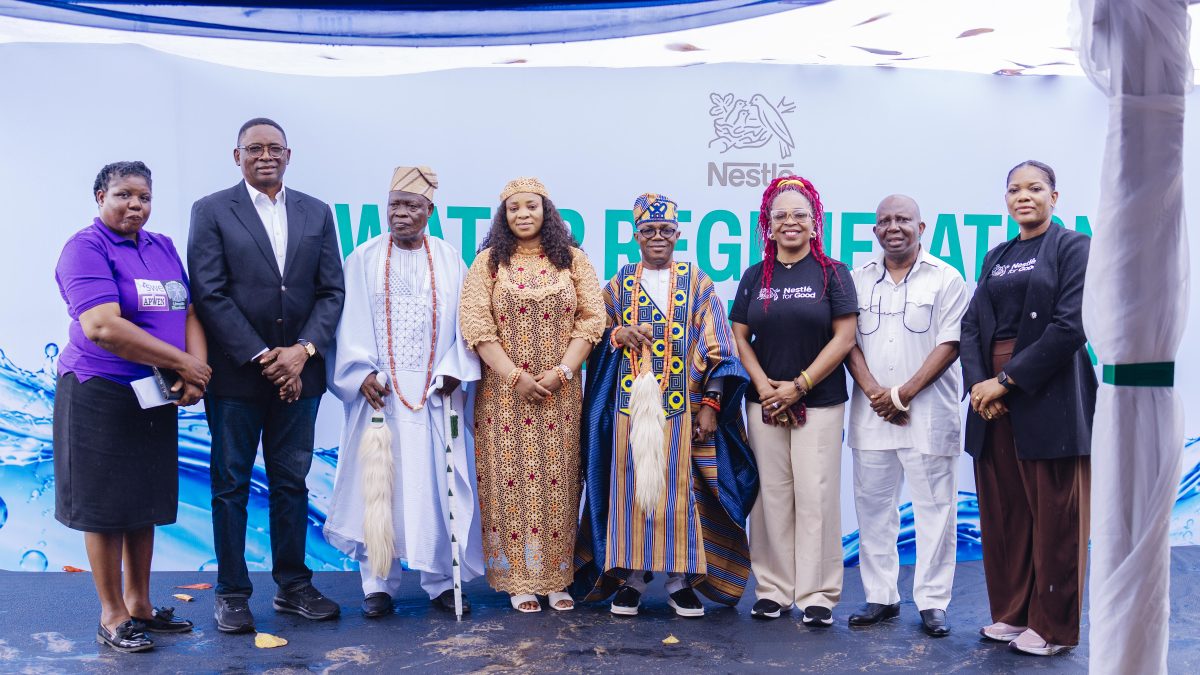
With eight climate-smart boreholes and water treatment plants commissioned in Ogun State, Nestlé Nigeria is combining infrastructure investment with water conservation and community-led governance to strengthen sustainable access to safe water.
Nestlé Nigeria Plc is strengthening its commitment to environmental sustainability and community development by linking access to safe water with conservation measures and local governance, as the company commissioned eight climate-smart boreholes and water treatment plants in communities within the Agbara catchment in Ogun State.
The intervention forms part of the company’s wider Water Regeneration Project, which covers the Agbara catchment in Ogun State and the Abaji catchment in the Federal Capital Territory. The project is designed around 24 climate-smart boreholes, comprising eight in Agbara and 16 in Abaji, alongside measures to improve water quality, promote conservation and strengthen community responsibility for maintaining the facilities.
Beyond expanding access to water, the initiative reflects Nestlé Nigeria’s approach to addressing the interconnected challenges of water availability, safety and long-term sustainability. By combining physical infrastructure with water treatment, rainwater harvesting, monitoring and community governance, the project seeks to establish a system capable of delivering lasting benefits to host communities.
For Nestlé Nigeria, the intervention also connects responsible water management with watershed resilience and business continuity, demonstrating how environmental stewardship can be integrated with community investment.
Speaking at the commissioning, Olutayo Olatunji, Business Executive Officer, Nestlé Waters and Premium Beverages, Nestlé Nigeria Plc, described the Agbara project as an important milestone in the company’s efforts to support the regeneration of local water cycles.
“The Agbara commissioning is an important milestone within our wider Water Regeneration Project and reflects Nestlé’s commitment to helping regenerate local water cycles,” Olatunji said.
He explained that combining treated water infrastructure with local governance and performance monitoring would help improve access, strengthen watershed resilience and deliver enduring value to communities.
Olatunji added that the company’s focus would remain on rigorous project delivery and measurable outcomes as work progresses on the remaining components of the initiative.
Beyond Infrastructure: Building a Sustainable Water System
A defining feature of the Water Regeneration Project is its four-pillar framework, which addresses water access, water quality, water conservation and water governance as interconnected priorities.
Under the water access component, the project provides for 24 climate-smart boreholes across Agbara and Abaji. The water quality pillar incorporates treatment plants, routine monitoring, the National Water Quality Advocacy Campaign and practical guidance to help communities understand and maintain safe water practices.
Water conservation is supported through rainwater harvesting systems, while the governance component focuses on strengthening community water, sanitation and hygiene committees through training and clearly defined responsibilities.
These committees are expected to play an important role in preventive maintenance, fault reporting, water quality checks and local oversight. By building community capacity alongside infrastructure, the project seeks to establish clearer lines of responsibility and encourage residents to protect the facilities for continued use.
The emphasis on governance is particularly significant because the benefits of water infrastructure depend not only on its installation but also on its continued functionality, proper maintenance and the quality of water supplied.
For communities receiving the facilities, the approach places local participation at the centre of long-term sustainability.
The Honourable Minister of Water Resources and Sanitation, Engr. Prof. Joseph Terlumun Utsev, underscored this point, noting that the commissioning of a facility represents only the beginning of its service to a community.
“Commissioning a facility is only the beginning; ensuring that it continues to provide safe, reliable and sustainable service is the true measure of success,” Utsev said.
He welcomed the project’s emphasis on governance and water stewardship, particularly the development of a governance training manual for water regeneration and stewardship.
His remarks highlighted the importance of maintaining water facilities after commissioning, ensuring that infrastructure investments translate into reliable services for the communities they are intended to support.
Public-Private Collaboration for Environmental Sustainability
The project also demonstrates the role of collaboration between businesses, government institutions, regulators and host communities in addressing water-related challenges.
The Honourable Minister of Environment, Balarabe Abbas Lawal, described the initiative as an example of what strategic public-private collaboration could achieve in advancing sustainable and equitable access to safe drinking water.
He said the partnership involving Nestlé, regulators, local authorities and host communities supported Nigeria’s environmental priorities and contributed to the objectives of Sustainable Development Goal 6, which focuses on clean water and sanitation.
Such collaboration brings together infrastructure investment, public oversight, technical expertise and community participation, creating a framework through which water projects can be managed beyond the initial construction and commissioning stages.
The involvement of traditional institutions and local water committees also provides a community-level structure for promoting responsible use, reporting operational problems and supporting the long-term maintenance of the facilities.
Welcoming the project on behalf of the host community, His Royal Majesty, Oba (Barr.) Lukman Jayeola Agunbiade, the Alagbara of Agbara Kingdom, described access to safe water as fundamental to the health and welfare of residents.
“Safe water touches every part of our lives: the health of our children, the dignity of our homes and the hopes of our families,” the monarch said.
He urged traditional leaders, WASH committees and residents to protect the facilities, guard against misuse and report faults promptly.
The monarch also emphasised the community’s responsibility to sustain the infrastructure, noting that its long-term value would depend on how effectively residents took ownership of the facilities.
His message reinforced a central principle of the project: that lasting community benefits require both investment in infrastructure and the commitment of local stakeholders to preserve it.
Taking Water Safety Knowledge Beyond Project Sites
Alongside infrastructure development, Nestlé Nigeria is supporting efforts to improve public understanding of water safety and responsible water management.
Victoria Uwadoka, the company’s Corporate Communications, Public Affairs and Sustainability Lead, said the National Water Quality Advocacy Campaign and the National Water Quality Handbook were developed in collaboration with the Federal Ministry of Water Resources and Sanitation and OPS-WASH to extend water safety knowledge to homes, schools, communities and institutions.
“Access alone is not enough. Water must be safe, it must be protected, and communities must have the knowledge to manage it responsibly,” Uwadoka said.
The initiative recognises that sustainable access to water involves more than the availability of a borehole. Communities also need practical knowledge about water quality, safe handling, infrastructure protection and responsible consumption.
By connecting advocacy and public education with the provision of water facilities, the programme seeks to reinforce the relationship between access, safety and stewardship.
This combination of infrastructure and awareness is intended to support better water management practices while strengthening community participation in protecting local water resources.
Advancing Water Stewardship and Long-Term Impact
The commissioning of the Agbara facilities marks a milestone in the wider Water Regeneration Project, which is designed to combine access to safe water with conservation, monitoring and governance.
The eight commissioned boreholes and treatment plants represent the completed Agbara component described by the company, while the 16 boreholes planned for Abaji remain part of the programme’s wider scope.
As work progresses in the Federal Capital Territory, Nestlé Nigeria has said it will maintain its focus on disciplined delivery, transparent validation and strong local ownership.
The project’s longer-term impact will depend on the reliable operation of the facilities, continued monitoring of water quality, effective maintenance arrangements and the ability of community structures to sustain their responsibilities.
By integrating these elements, Nestlé Nigeria is pursuing an approach to water stewardship that extends beyond infrastructure provision to include the systems and partnerships required to protect its value over time.
For the communities involved, the objective is to secure more sustainable access to safe water while building local capacity to manage essential resources responsibly.
For the company, the project connects community investment with watershed resilience and responsible water management, placing environmental sustainability alongside the long-term needs of the communities in which it operates.
Ultimately, the significance of the Water Regeneration Project will be measured not only by the facilities commissioned but also by their continued functionality, the quality of water delivered and the extent to which communities can sustain the benefits for years to come.


